
This page covers assignable keys. They differ from the keyboard shortcuts in part 1 in one important way: those work while the cue list has focus, and these work anywhere in the program.
Where to set them
Settings → Outputs, at the bottom of each playout’s section, under Shortcuts. Click a field, press the key. Backspace clears it, Esc cancels.
They sit there rather than on a page of their own because a shortcut belongs to one broadcast line, like that line’s output and its audio track.
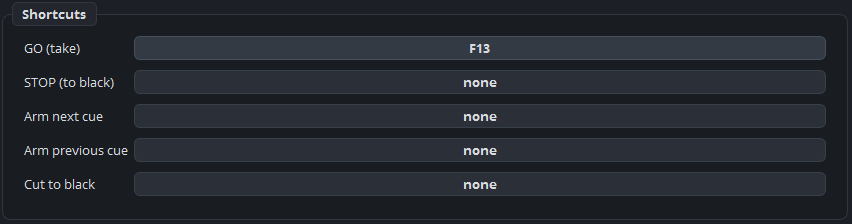
The five actions
| Action | What it does |
|---|---|
| GO (take) | Takes the armed cue to air. |
| STOP (to black) | Stops the playout. |
| Arm next cue | Moves the green marker down. |
| Arm previous cue | Moves it up. |
| Cut to black | Black, immediately. |
A module can add more — a presentation module brings the two clicker actions that step a speaker through their own slides.
A set per playout
Every playout has its own five. That is the point of them sitting under that playout: a key assigned there drives that line, whatever is active on screen.
On a desk with two lines, assign both sets: one hand always means playout 1 and the other always means playout 2, with no chance of firing the wrong one because you clicked the wrong panel a minute ago.
That is the difference with the keyboard shortcuts from part 1, which always act on whichever playout is active.
Where the assignments are kept
The program stores and reloads them itself. That is not the engine’s doing: the engine does not keep hotkey assignments for plugins, so the program had to handle it — which it does, per installation.
Practical advice
Choose keys nothing else uses. F13–F24 are ideal if your keyboard has them, because nothing else in Windows does.
Avoid the space bar and Enter — those already work in the cue list, and assigning them as global keys makes their behaviour depend on where the focus happens to be.
Write them down and tape the list to the desk. The operator on Sunday is not the person who assigned them.