
This page covers a playout put into overlay mode: it carries only the layer that is laid over the picture, full screen, and nothing else. It exists for one job — feeding a key input on a vision mixer, so that graphics can be laid over a picture the mixer is cutting itself.
What it is
Switched on, that playout draws nothing but the output page: the graphics that are live over the picture at that moment, on a transparent background, full screen.
Along with that it gives up everything a normal playout has:
- No cue list. There is nothing to fire.
- No audio.
- It cannot be selected, so it cannot be used for something else by mistake.
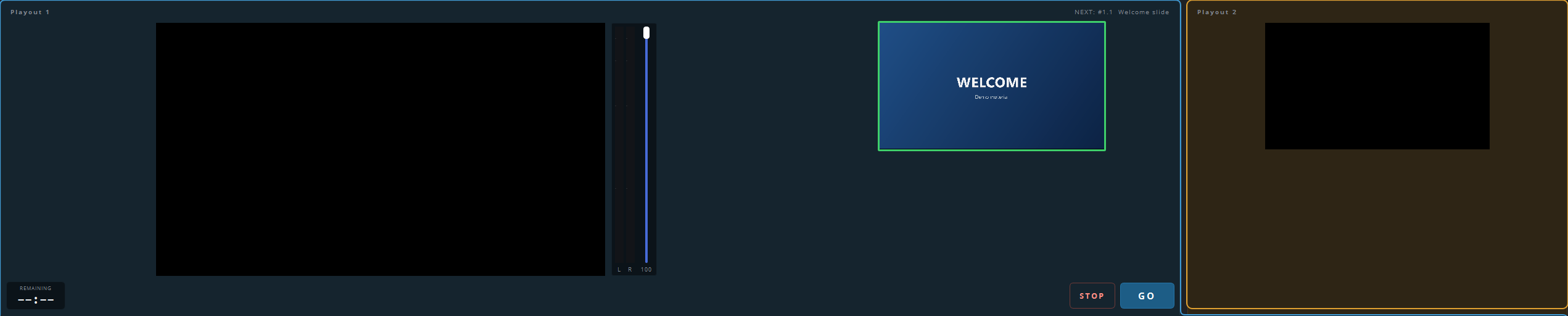
Its panel drops to half size, without transport, meters or NEXT, and a border runs all the way round it, so that at a glance you can see this line is fixed rather than idle.
Switching it on
Settings → Outputs, on that playout’s tab, under Options: Overlay output only.
Give it an output that carries the overlay to where it is needed — usually NDI or an SDI card with fill and key.
Transparency, and when to give it a background
The output page is transparent. Whether that survives depends on the output:
| Output | Setting |
|---|---|
| NDI, or DeckLink with fill+key | Leave the background off — the alpha travels with the picture |
| A projector, or a card without key | Switch on Background colour instead of transparent, and key on that colour further down the chain |
The background colour is yours to pick. The usual choice is a green or blue that does not occur in your graphics.
What appears on it
The playout itself puts nothing on this layer. It is empty unless a module supplies graphics; in a base installation the overlay output is a transparent, empty feed.
The usual arrangement
One playout runs the programme and feeds the stream. A second is set to overlay only and feeds the mixer’s key input. The mixer lays the graphics over whatever it is showing — a camera, a slide, the programme feed itself — and the operator never has to think about which of those it is.