
This page covers everything between double-clicking the icon and having a usable, empty cue list in front of you. It explains what the loading screen is doing, where the program keeps your files, how to set the interface language, and which of your choices survive a restart. It is the page to come back to when you wonder “where did that file go” or “why is this machine in the wrong language”.
Starting
Start the program from its own shortcut — the desktop icon, the Start menu or the taskbar — never from anything inside the program folder, which gives you an interface that is only half taken over.
You get a splash screen, then a dark loading screen with the wordmark and one line telling you how far along it is:
| Line | What is happening |
|---|---|
| Starting up… | The program is loading. |
| Loading modules… | Your modules are being started. |
| Building the interface… | The window is being assembled. |
| Starting playouts… | Previews and outputs are coming up. |
The loading screen stays until the interface is ready. A few seconds on a cold machine is normal.
A start that takes noticeably longer than usual is almost always a module waiting on something — a network drive, a service that is not answering. The line on the loading screen tells you which stage it is stuck in.
The folders in Documents
On the first start the program creates its own folders:
DocumentsUltimate Playout
  Lists      <- your cue lists (.playout)
  Exports    <- what you export: groups, bundles, selections
  Songs      <- empty in a base installation
These are ordinary folders. You can back them up, put them on a network share, or copy them to another machine — a cue list from one installation opens on another, as long as the media it points at is reachable there too.
Open and Save start in Lists, so in day-to-day use you never have to navigate anywhere.
The
Songsfolder is always created; it stays empty unless a module writes to it.
Choosing your language
The interface is available in English, Dutch, German, Norwegian and Spanish. The program starts in the language you chose in the setup; to change it afterwards:
- Click the gear at the right end of the toolbar.
- Go to General → Language.
- Choose your language and confirm.
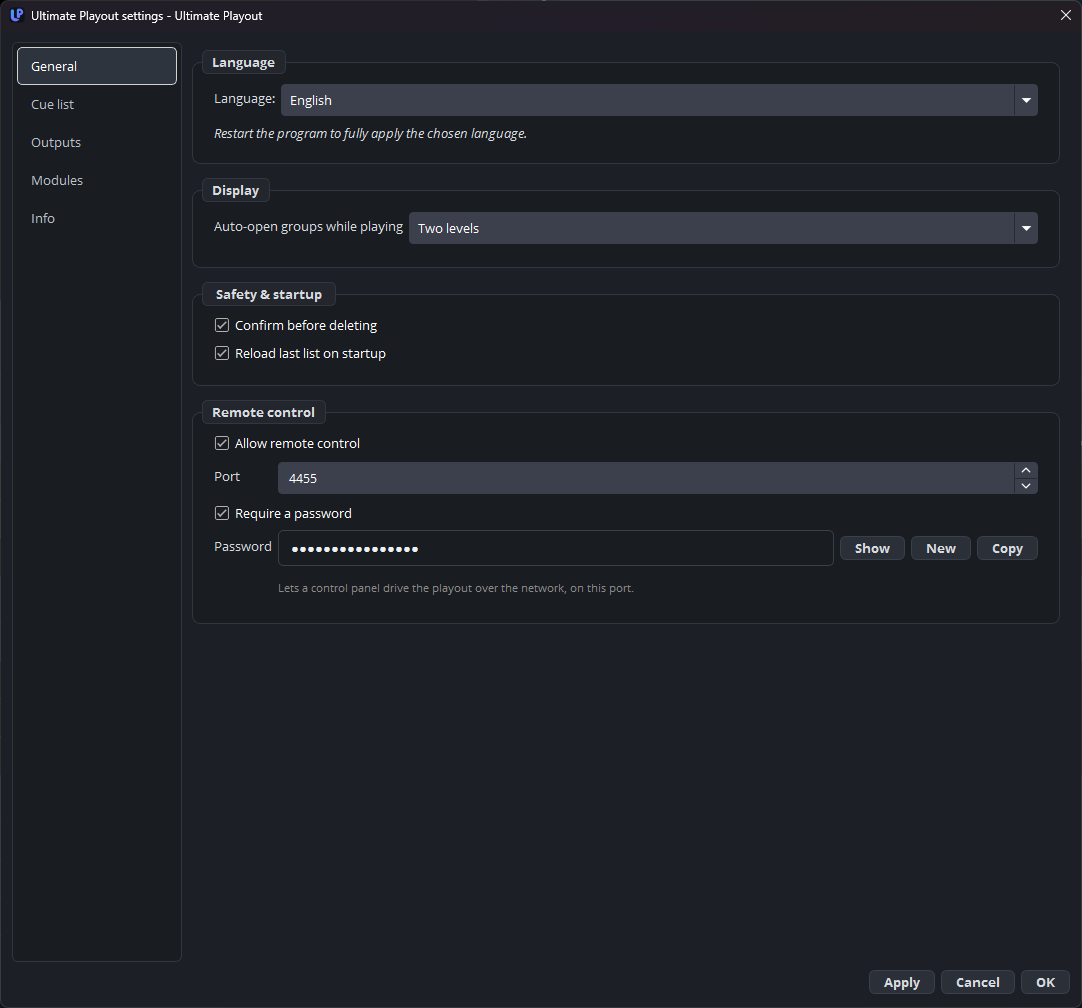
The categories down the left are General, Cue list, Outputs, Modules and Info.
Restart the program afterwards to apply it completely. Most of the interface changes immediately, but a few texts are only built once at startup and keep the old language until then.
The language belongs to the machine, not to a cue list: opening a list someone else made does not change your language.
What the program remembers
Between sessions it keeps:
- The window layout — the width of the cue list and of the item pane, per playout.
- Whether the item pane was open.
- Your settings, including outputs, the number of playouts, colours and names.
- The last cue list, if Reload last list on startup is switched on under General. That is the setting that decides whether you come back to Sunday’s rundown or to an empty list.
All of it lives with the program, in its configuration folder — not in your Documents folder. That has one consequence worth knowing on a shared machine: everyone who logs in on that PC shares the same settings. For a control-room computer with changing volunteers that is what you want. If you need personal setups, use separate machines or separate Windows installations.
What you see when it is ready
An empty cue list, one monitor panel with a black preview, and a toolbar. Empty is the normal state on a first start: nothing is on air, nothing is armed, and no output is running yet.

If your window is missing buttons that colleagues have, that is not a fault — those buttons come from modules that are not installed or not switched on here. Check Settings → Modules.